Financial NLP service
NLPInsight Analyzer
Classify financial text sentiment — and understand why domain-specific pre-training matters more than model size.
The Problem
Financial markets generate 10,000+ news articles/day. Manual sentiment review costs $50–100/hour per analyst. Automated classification must handle domain nuance: "revenue declined less than expected" is positive in financial context — a pattern that bag-of-words models consistently misclassify.
Business Translation
Problem
Financial text is noisy
Market language carries domain nuance, abbreviations and class imbalance that a generic sentiment demo can hide.
Decision
Use a lightweight production path
TF-IDF + Logistic Regression keeps inference fast, small and explainable for resource-constrained deployment.
Impact
Useful under cost constraints
The service trades some accuracy upside for latency, image size and operational simplicity.
Trade-off
FinBERT stays optional
The heavier transformer path is documented, but not forced into the default runtime without GPU and cost justification.
Why Accuracy Works Here (and F1-Macro as Guard Rail)
The dataset has 3 classes: 58.0% neutral, 26.9% positive, 15.1% negative. Trained on Twitter Financial News Sentiment (11,931 real tweets) — noisy, informal text with stock tickers and abbreviations. F1-macro (0.748) guards the minority negative class — the highest-value signal for risk management.
| Metric | TF-IDF + LogReg (production) | FinBERT (GPU) | Why It Matters |
|---|---|---|---|
| Accuracy | 80.6% | ~85-88%* | Honest metric on hard, noisy tweets |
| F1 (weighted) | 0.810 | ~0.85* | Overall system performance weighted by class frequency |
| F1 (macro) | 0.748 | ~0.82* | Safety guard: ensures minority negative class isn't neglected |
* FinBERT fine-tuning requires GPU. Estimated from published benchmarks.
80.6% on real financial tweets (vs 97% on the easier Financial PhraseBank) is an honest, defensible metric. The dataset upgrade from curated sentences to noisy tweets better demonstrates real-world NLP capability.
Architecture
flowchart TD
    A[Text Input] --> B[SentimentPredictor\nAuto-detect]
    B --> C{model.joblib\nexists?}
    C -->|Yes| D[TF-IDF Vectorizer\nmax 10K features]
    D --> E[LogisticRegression\nclass_weight=balanced]
    C -->|No| F{config.json\nexists?}
    F -->|Yes| G[FinBERT Tokenizer\nmax 256 tokens]
    G --> H[ProsusAI/FinBERT\n110M params]
    H --> I[Classification Head\n+ Softmax]
    E --> J[negative / neutral / positive\n+ confidence scores]
    I --> J

    style D fill:#2d6a4f,color:#fff
    style E fill:#2d6a4f,color:#fff
    style G fill:#7b2cbf,color:#fff
    style H fill:#7b2cbf,color:#fff
    style I fill:#7b2cbf,color:#fff
Green = Production path (TF-IDF, 5ms, 267 MB) · Purple = GPU path (FinBERT, 87ms, 1.4 GB)
Why TF-IDF in production: TF-IDF runs in 5ms (in-pod) with a 267 MB image vs FinBERT's 87ms with a 1.4 GB image. For latency-critical pipelines, the accuracy trade-off (80.6% vs ~88%) is acceptable. The training pipeline supports FinBERT fine-tuning when GPU is available.
Engineering Trade-Off
Chosen: small, fast, explainable default model. Rejected: making the heaviest model the default before the serving cost and GPU requirement are justified.
This follows the same operating principle used in the BankChurn debugging deep dive: production ML choices should be measured against runtime behavior, not only model score.
Code Review Shortcuts
Operational
| Metric | Value | Context |
|---|---|---|
| Test Coverage | 98% (74 tests) | CI threshold: 85% |
| Docker Image | 267 MB | nlpinsight:v3.6.0 on Artifact Registry (no torch dependency) |
| Model Size | ~5 MB (TF-IDF+LogReg) | Downloaded via Init Container from GCS |
| P50 / P95 Latency | 78ms / 140ms (GCP), 100ms / 120ms (AWS) | Through ingress, Locust smoke test (6 users) |
Responsible AI
- Fairness: Per-class F1 parity monitored; no class F1 below 0.90
- Drift: Sentiment distribution monitored via Prometheus (
nlpinsight_predictions_total{sentiment}); shift alerts calibrated as relative change from 7-day baseline (not absolute — a market crisis legitimately shifts the distribution) - Validation: Pandera schemas for input text and label format
Live Prediction
| Swagger UI | Sentiment Prediction |
|---|---|
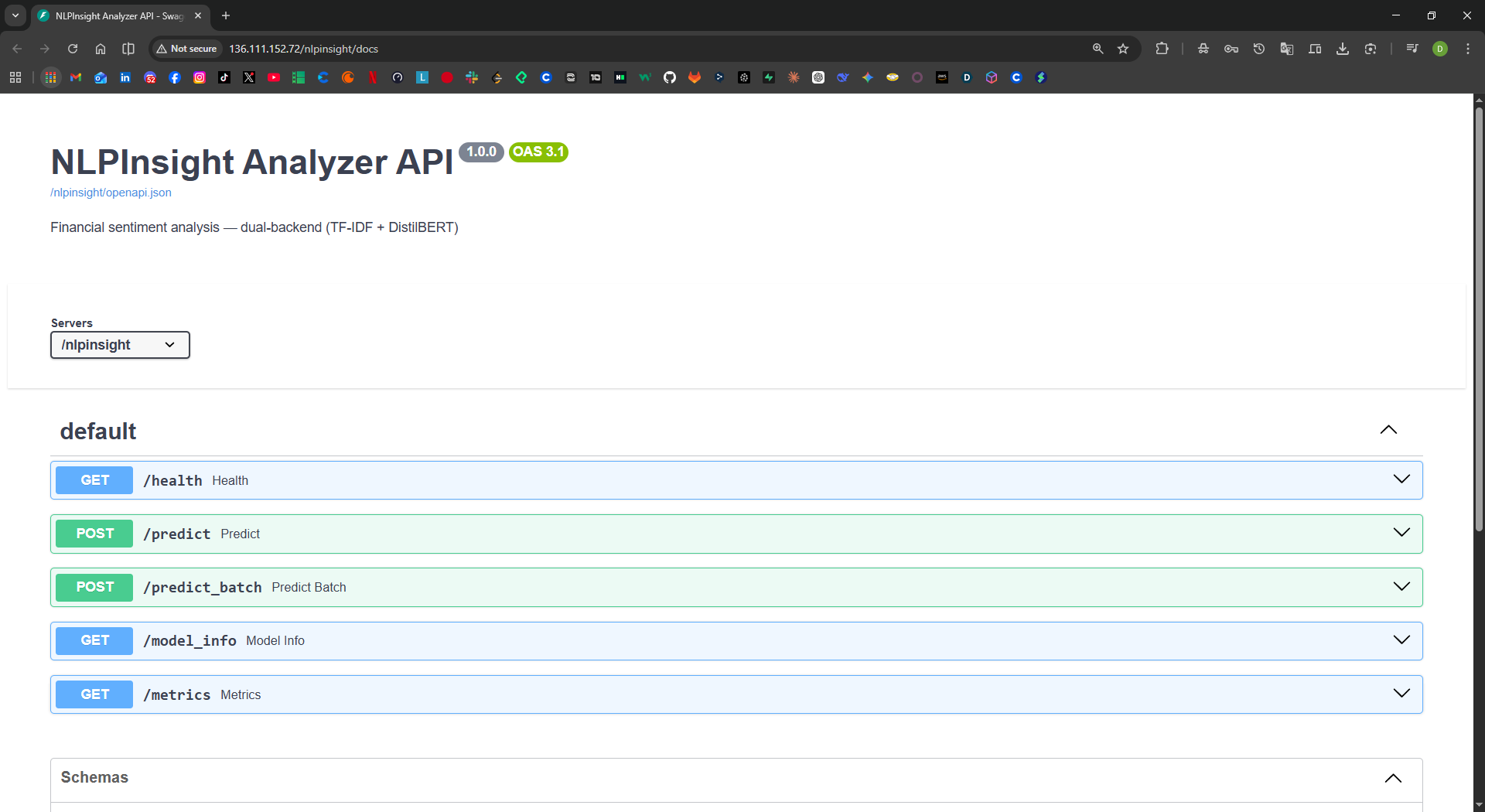 |
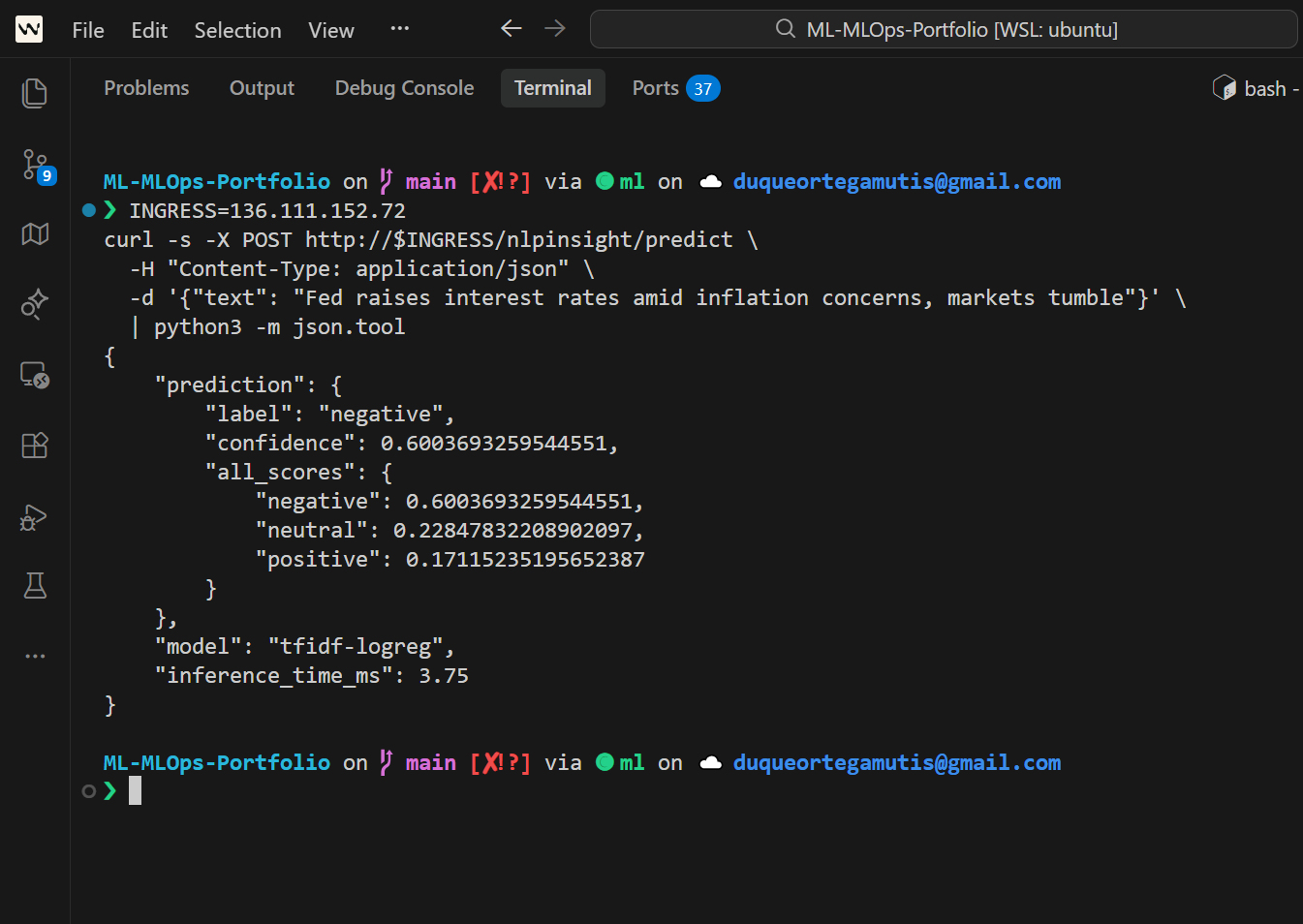 |
Try It
curl -s -X POST http://localhost:8003/predict \
  -H "Content-Type: application/json" \
  -d '{"text":"Fed raises interest rates amid inflation concerns, markets tumble"}' \
  | python3 -m json.tool
Expected: sentiment (negative), confidence (~0.7+), probabilities per class.
📄 Full Model Card — includes metric rationale, performance benchmarks, and production decision narrative.
Related Operating Evidence
Last Updated: April 2026 — v3.6.0